
With many people using these terms interchangeably, that’s a mistake since Generative AI, Agentic AI, and AI Agents are different
Distinguishing the differences is important to making good product and business decisions as follows –
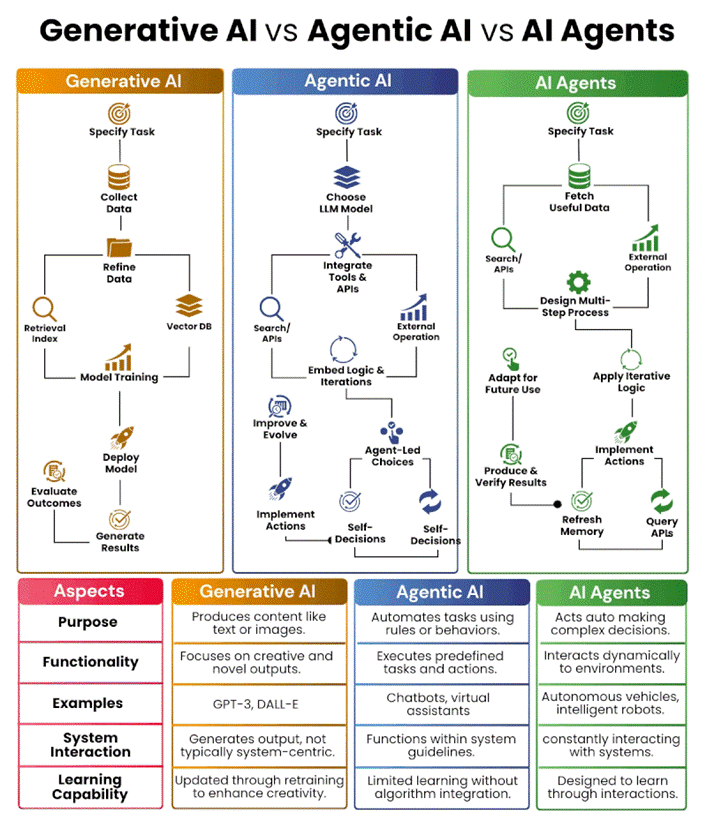
- Generative AI : is where most people become familiar with AI. You give a prompt and get an answer. This is typically text. Images, or code. While Gen AI is powerful, it’s reactive with no real decision-making or follow up execution.
Think – content creation engines.
- Agentic AI : is the transition phase where AI doesn’t just respond to questions, it plans, reasons, and decides within guidelines what to do. For example – Choose a tool or tools / Call API or APIs / Execute steps logically / etc. While still guided and controlled, Agentic AI is far more useful for workflows.
Think – AI with intent.
- AI Agents : is where things get serious since they can – Act autonomously / Adapt to environments / Learn from outcomes / Execute multi-step tasks end-to-end / etc. Importantly AI Agents don’t wait for prompts, they operate systems and perform processes.
Think – digital workers.
Why does this matter ?
Because, if you’re using Generative AI where you need Agents, you will hit a ceiling – fast. If you deploy AI Agents without guardrails, you will create chaos and get surprises with unintended consequences that expose people and the organization to liability and unnecessary risk.
To get past these issues, select the right tool to have the best solution, a better system architecture, improved user experiences, make innovation more rewarding, achieve an impressive ROI, etc. With this, realize we’re moving from “ AI that talks ” → “ AI that does work ”.
To meaningfully improve outcomes, innovate for impact, better position the organization to evolve, be good at experimenting, creating new value and opportunities, etc.
…. by building the appropriate Agent-First Systems.
With this, also recognize –
- The real shift happens when we move from ‘ Generative ‘ (content focus) to ‘ Agentic ‘ (process focus). The biggest value is in Multi-Step Iterative Logic (the green column). It’s not just about getting an answer – it’s about creating a system that can verify its own results and adapt. This is where AI stops being a basic tool and starts being a ‘ business asset ‘. And realize “ Orchestration “ is the new gold.
- Most “ Agent ” products are Generative AI with a tool button. When you name the layer correctly, your roadmap gets clearer fast. A simple way to enforce it is to write down what the system can do without a human prompt.
- Organizations hit scalability or security ceilings by confusing reactive content generation with autonomous execution. Deploying AI Agents without proper guardrails isn’t just a workflow risk — in AI security, it can create real exposure points for model exploitation or IP leakage. The real leverage comes when you combine agent-first architectures with robust monitoring, threat modeling, and governance, allowing systems to execute tasks autonomously without introducing operational or security chaos. This kind of clarity in architecture isn’t just about ROI; it’s about building systems that are both highly capable and resilient.
- The real shift starts when agents are connected to governed enterprise systems. The challenge then is no longer capability – but identity, access control, auditability and operational reliability.
- The ‘ costly gap ‘ point hits hard. Unfortunately, most people get stuck looping prompts through ChatGPT for tasks that clearly need tool-calling and multi-step reasoning. They don’t even know they’re in that gap. The tricky part isn’t the tech – it’s recognizing the difference between ‘ AI that answers ‘ and ‘ AI that does things ‘. To facilitate understanding, the lightbulb typically goes on when a person sees an AI Agent process an invoice or triage support tickets.
- A lot of companies expect autonomy from something that was only built to generate outputs, then wonder why it hits a ceiling. Generative AI is reactive by nature, while AI Agents require orchestration, boundaries, and real workflow thinking. Different layers, different responsibilities, and definitely different infrastructure behind the scenes.
- To summarize – Generative AI creates, Agentic AI plans (within boundaries), and true AI Agents execute and adapt. Mixing them up leads to poor outcomes, mismatched expectations, fragile systems, wasted time and money, etc.
March 5, 2026 CAIL Innovation Commentary info@cail.com www.cail.com 905-940-9000